Indoor vs Outdoor LED Displays: How to Pick the Right One (Without the Jargon)
Published on: June 18, 2026
"Can I use the same LED screen outside as I use inside?"
This is the first question most Indian business owners ask us. The short answer is no. Indoor and outdoor LED displays look similar. But they are engineered very differently. Put an indoor screen outdoors, and one monsoon later it is not functional.
In this guide, we explain the real differences in plain words. Use it as a checklist before you sign any LED display order.
Quick answer:
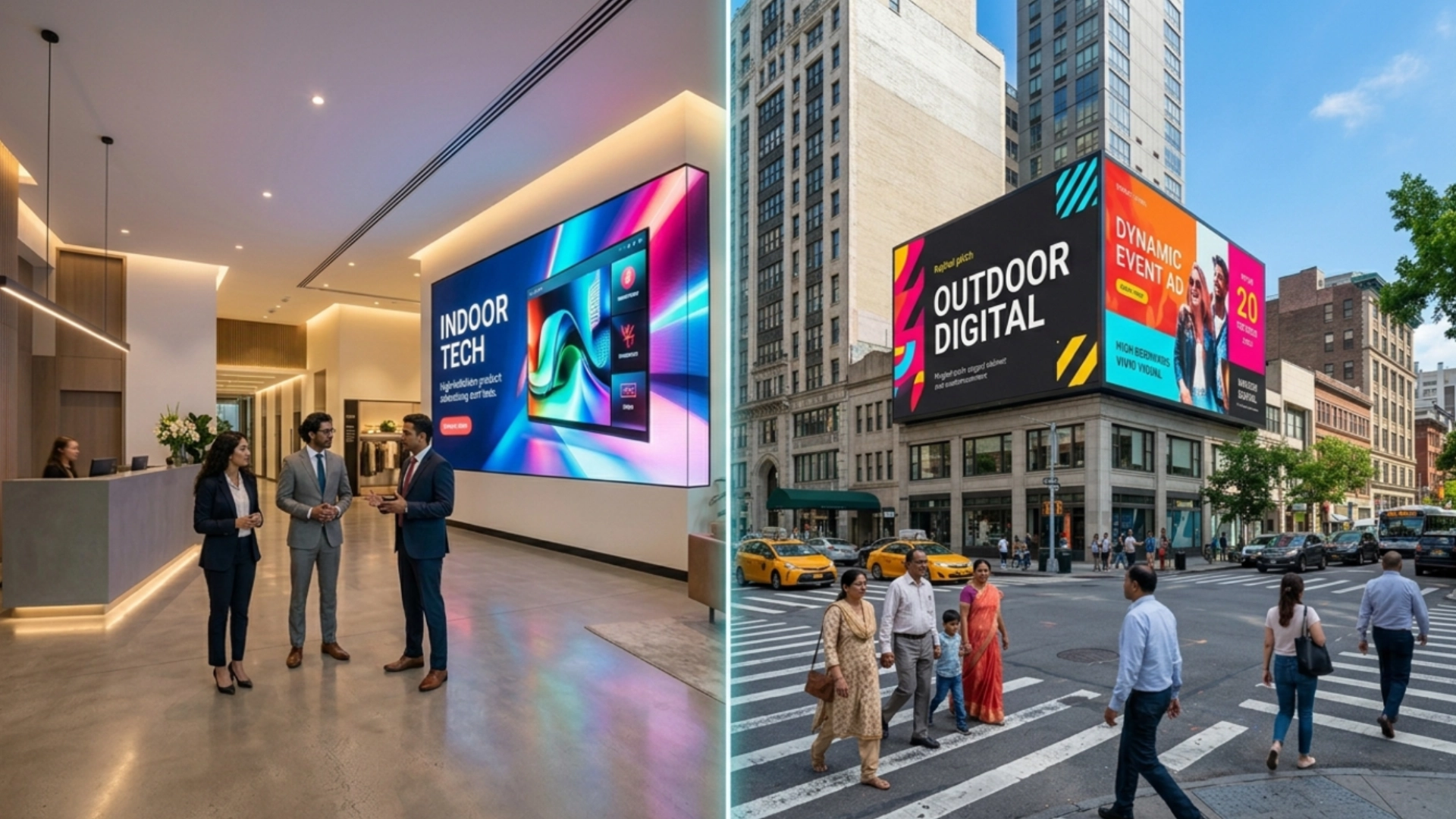
Indoor LED displays are tuned for controlled light, short viewing distance and fine pixel pitch. Outdoor LED displays are built tougher — higher brightness (5,000+ nits), IP65 waterproofing, and pixel pitch designed for viewing from far off distances.
The Four Deciding Factors — Side by Side
| What matters | Indoor LED display | Outdoor LED display |
|---|---|---|
| Brightness (nits) | 800 – 1,500 | 5,000 – 10,000 |
| Pixel pitch (mm) | 0.9 – 2.5 (fine) | 2.9 – 20 (wider) |
| IP rating | IP30 (dust-resistant) | IP65 & IP66 (rain + dust) |
| Typical life | 100,000+ hours | 80,000+ hours (harsher load) |
Brightness: The One Number That Changes Everything
Indoor lighting conditions are controlled, with illumination mainly coming from LED displays and limited natural light from a few windows. Because the environment is not exposed to direct sunlight or excessive brightness, a display brightness level of 1,000 nits is more than sufficient for clear visibility and comfortable viewing.
Outdoor light in India is intense. On a summer afternoon in Delhi, the light can go up to 60,000–90,000 lux. In that kind of brightness, a screen needs more than 5,000 nits to be seen properly — anything lower starts to fade and becomes difficult to depict.
Related Blog: High Brightness and Power Efficiency: Key Factors for Outdoor LED Displays Functionality
That is why indoor screens do not work outside. They are not faulty — they are simply not designed for that level of ambient light.
Weatherproofing: IP65, IP54 and What They Really Mean
- IP65: Fully sealed to prevent dust and water from entering. This is the standard used for the front of outdoor screens.
- IP54: Splash-proof and dust-protected. Standard for the back/service side of an outdoor unit.
- IP30: Indoor-only. Handles dust. Does not handle water.
A Mumbai monsoon throws more than rain. It brings driving winds, salty coastal air and humidity that rusts ordinary steel in weeks. Xtreme's Earth series cabinets are designed with IP66 rating and best suited for harsh Indian weather conditions. Indoor cabinets are not.
Pixel Pitch: Why Indoor and Outdoor Use Different Sizes
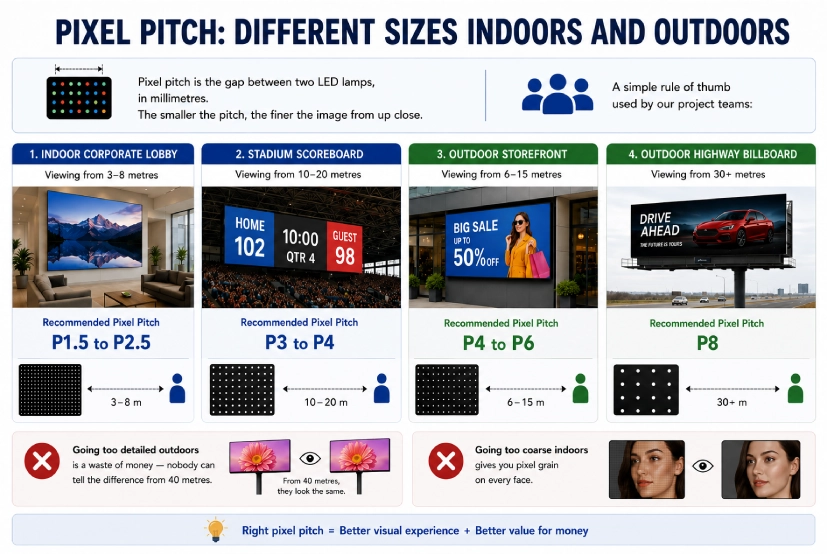
Pixel pitch is the gap between two LED lamps, in millimeters. The smaller the pitch, the finer the image from up close.
A simple rule of thumb used by our project teams:
- Indoor corporate lobby, viewing from 3–8 meters: P1.5 to P2.5
- Indoor stadium scoreboard, viewing from 10–20 meters: P3 to P4
- Outdoor storefront, viewing from 6–15 meters: P4 to P6
- Outdoor highway billboard, viewing from 30 meters: P8
Going too detailed outdoors is a waste of money — nobody can tell the difference from 40 meters. Going too coarse indoors gives you pixel grain on every face.
Cost: Why Outdoor Screens Cost More (And Why It Should)
Outdoor LED modules are built differently. They use more LEDs per cabinet, thicker aluminium, stronger drivers, better cooling, and connectors that are properly sealed to handle weather conditions.
But here is the catch: an untrusted outdoor LED display is the most expensive thing you can buy. It fails in 12–18 months, and replacement becomes a full teardown. A properly built outdoor display lasts 8–10 years with minor service.
6 Checkboxes Before You Buy an Indoor or Outdoor LED Display
- 1. Install location: Indoor, outdoor under shade, or fully exposed outdoor environment?
- 2. Viewing distance: Shortest and longest distance your audience will stand at.
- 3. Ambient light: Lux readings at peak daylight. Ask your partner to measure, not assume.
- 4. Running hours: Per day. 24x7 changes the cooling spec.
- 5. Content type: Text, video, live feed, data dashboard.
- 6. Service SLA: How fast will the OEM respond in your city?
The Bottom Line
Indoor and outdoor LED displays look similar, but they play very different roles. Pick wrong, and you either overspend or replace early.
At Xtreme Media, we build both — from the LIT fine-pitch indoor series to the Earth and Iris series which fall under the outdoor range. Tell us your location, distance and daily use. We will tell you exactly which grade fits.
Keep Reading
- What is an Active LED Display? A simple guide
- Active LED display vs TV vs projector
- Understanding pixel pitch — what P1.5, P2 and P10 really mean
FAQs
Q.1. What is the main difference between an indoor and outdoor LED display?
Brightness and weatherproofing. Indoor displays run at 800–1,500 nits with an IP30 (dust-resistant) build. Outdoor displays hit 5,000–10,000 nits with IP65 front sealing to survive sun, rain and dust.
Q.2. Can I use an outdoor LED display indoors?
Yes, but it is not the right fit. Outdoor screens are made for long viewing distances, so the pixels are spaced wider and content can look rough when viewed up close. For indoor use, a finer pitch like P1.5 to P2.5 gives sharper output and better value.
Q.3. What IP rating should I ask for in an outdoor LED display?
For Indian conditions, IP65 at the front and IP54 at the back is the bare minimum. IP66 is the most effective IP rating. Anything lower is likely to face issues during monsoons or in coastal cities like Mumbai and Chennai.
Q.4. How do I calculate the right pixel pitch?
Follow a simple rule: always match the viewing distance with the pixel pitch. For example, P1.5 works at about 1.5 meters, P6 at around 6 meters, and P10 from 10 meters or more.