Active LED Display vs TV vs Projector: Which One Truly Wins in 2026?
Published on: June 18, 2026
A school in Pune wants a screen for its auditorium. A car showroom in Ahmedabad wants a digital medium for its launch wall. A Bengaluru startup wants a big, bright backdrop for town halls. All three ask us the same question:
"Should we go with a TV, a projector, or an active LED display?"
It is one of the most common questions we hear from businesses before they invest in a display setup. The answer comes down to three factors — ambient light, viewing distance, and daily run hours. Let us break it down with real numbers.
Quick take:
A TV suits small rooms with controlled light. A projector suits dark rooms and occasional use. An active LED display wins everywhere — bright rooms, outdoor areas, curved surfaces and any screen that runs 24x7. For business use in India, an LED display is now the default choice.
The Three Technologies — In One Line Each
- TV (LCD or OLED): A sealed, factory-built screen with a fixed size, usually 32–98 inches. Great for living rooms. Struggles with sunlight and long uptime.
- Projector: A lamp that throws light onto a screen or wall. Cheap to install. Needs darkness. Needs a new lamp every 2,000–5,000 hours.
- Active LED display: A self-lit digital screen built from modules. Any size. Any shape. Bright outdoors. Built to run for years.
Round 1: Brightness
Brightness is measured in nits. The higher the number, the easier it is to see the screen when there is more light around.
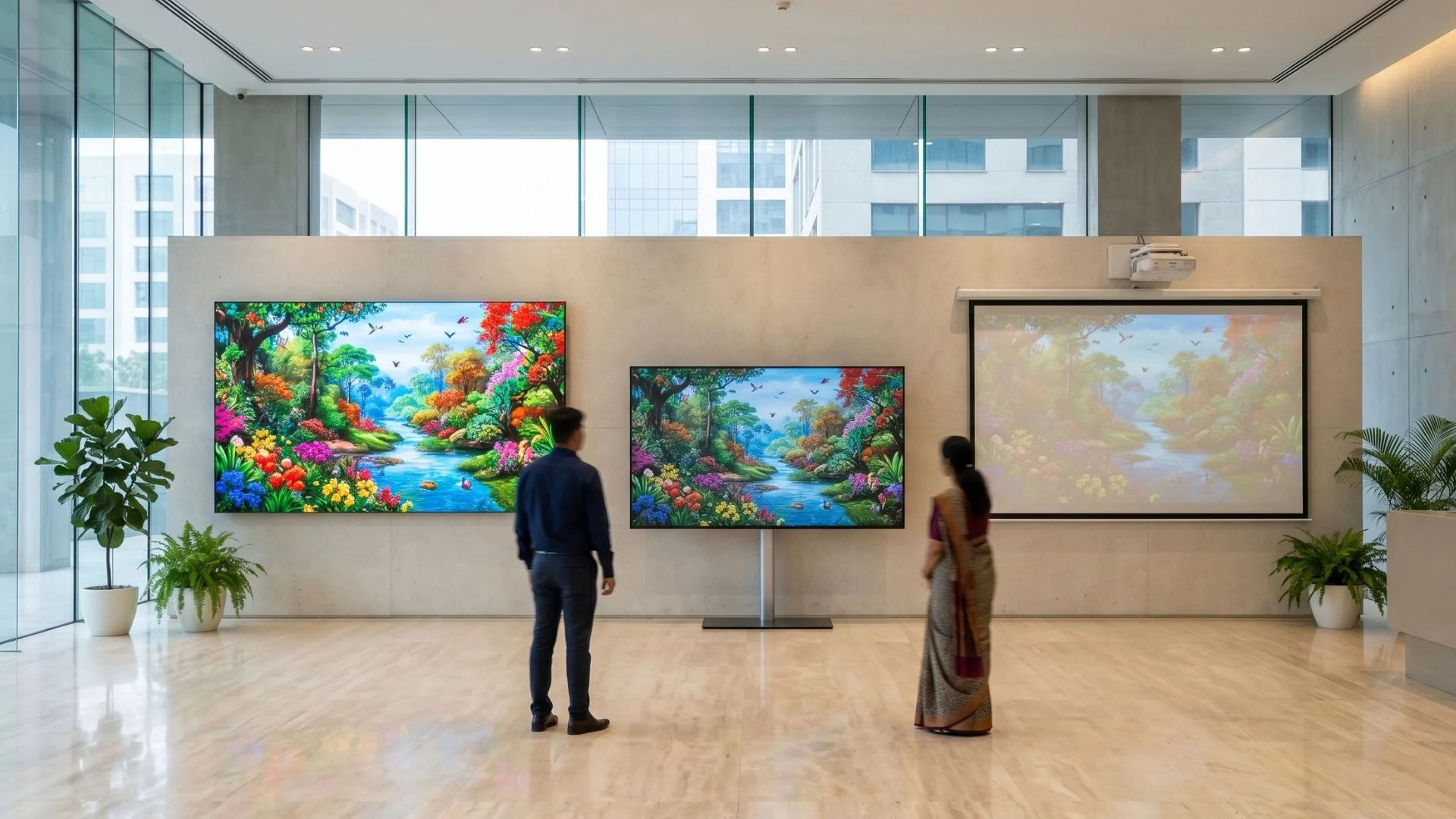
A TV generates 300 to 500 nits. A projector puts out 1,500 to 5,000 lumens — though in practice, that feels much lower than 1,500 nits once ambient light comes into the equation.
- Active LED display (indoor): 800–1,200 nits
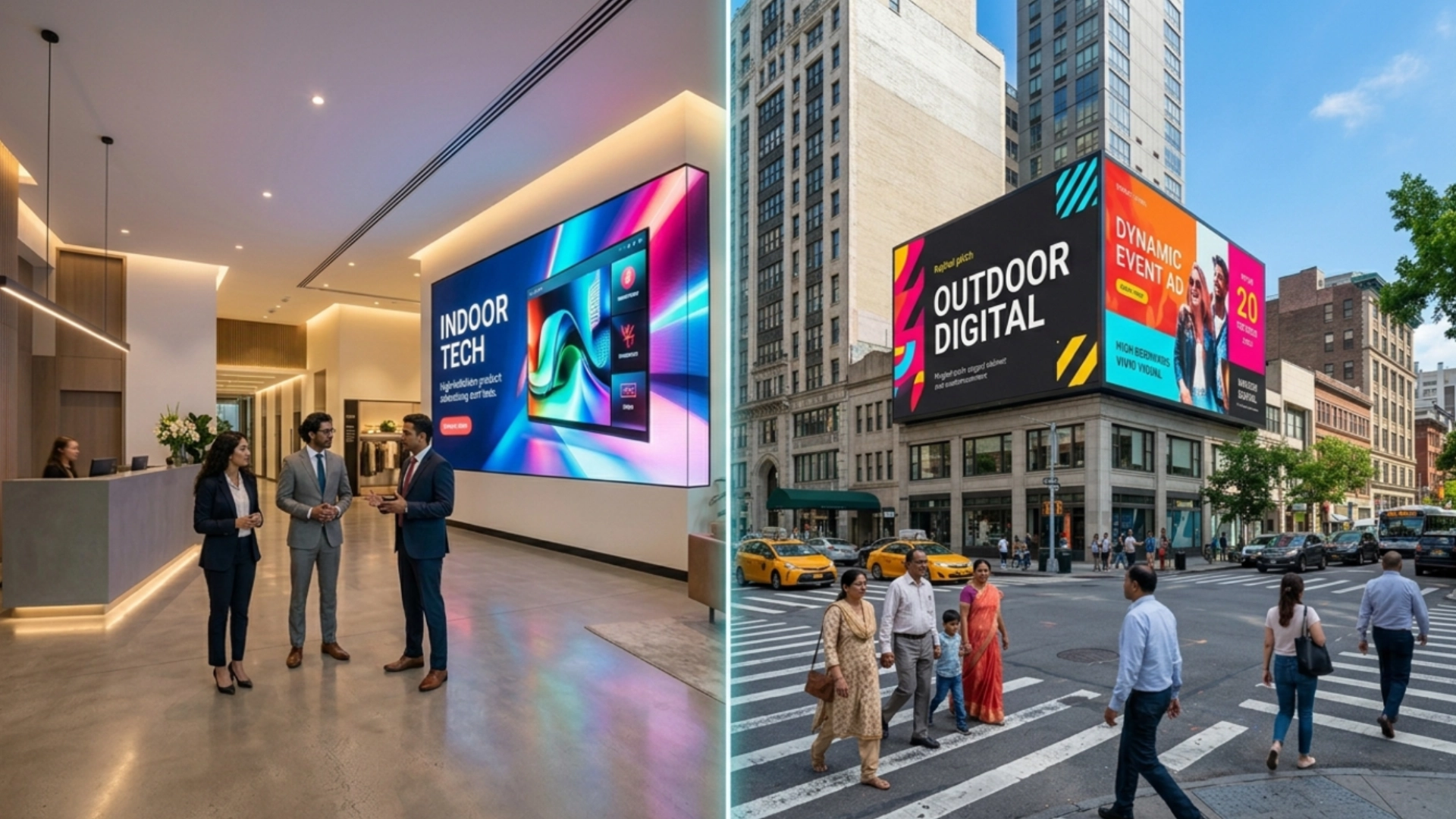
- Active LED display (outdoor): 5,000–10,000 nits
If your space has large windows, afternoon sun, or white marble floors — a TV will look washed out and a projector will appear faint. Only an LED display has the upper hand when it comes to matching your environment's lighting.
Round 2: Size and Shape
TVs stop at about 98 inches. After that, the bezel gap looks unaesthetic if you tile them.
Projectors can throw a huge image. But anything above 150 inches starts to look dim unless you have a dark cinema. And a projector does not come in curved designs that seamlessly integrate with your architecture.
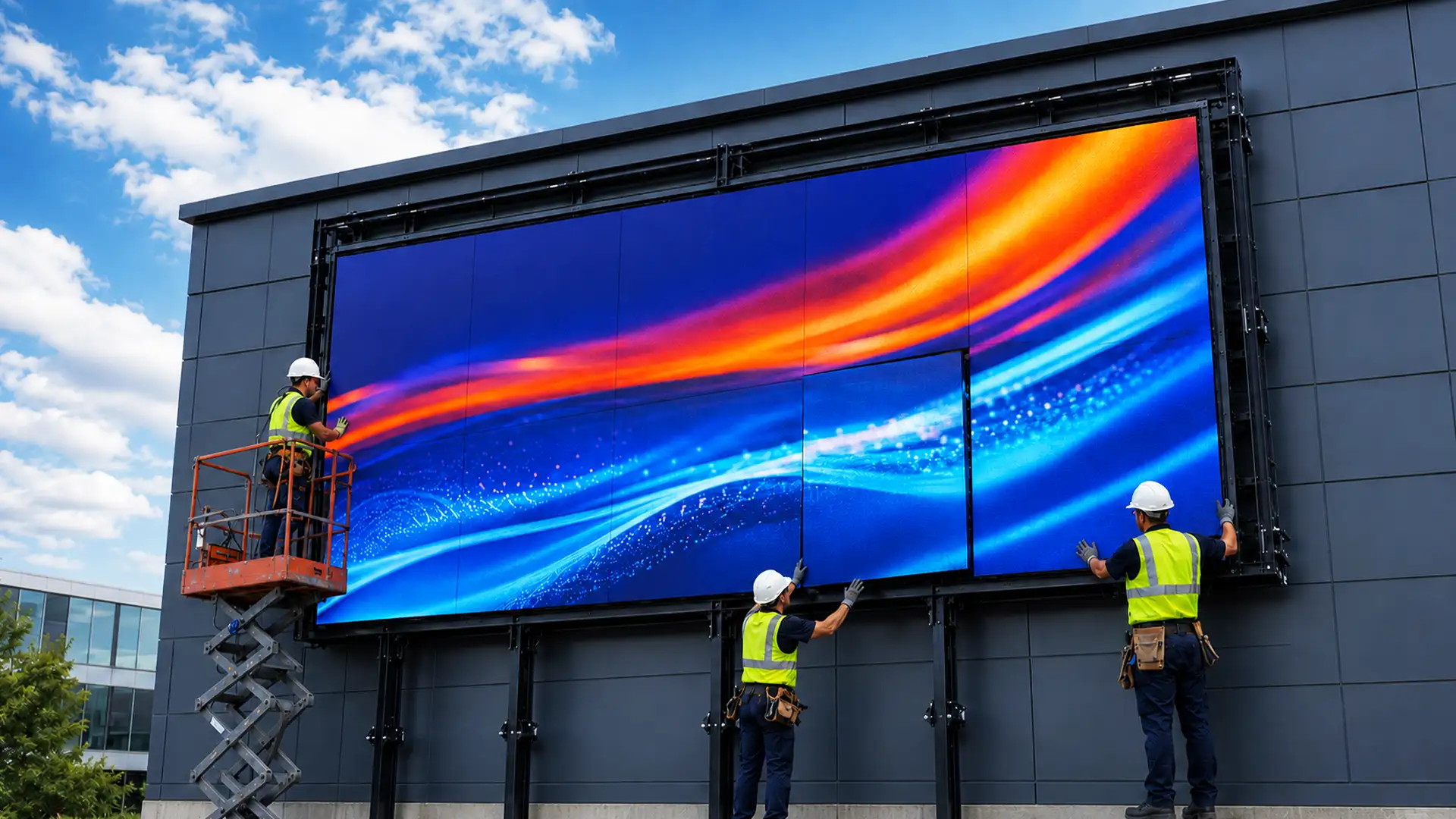
An active LED display is built like Lego. You decide the size. You decide the shape. We build 1 x 1 meter screens for meeting rooms and 30 x 10 meter walls for cricket stadiums. Same technology. Same engineers.
Round 3: Life Span and Total Cost of Ownership
This is the part no one tells you upfront.
- TV: 30,000–50,000 hours. 3–5 years at 12 hours a day. Out-of-warranty repair is rarely worth it. You replace it.
- Projector: The lamp dies every 2,000–5,000 hours. That is 1–2 lamps a year at normal use. Plus the bulb cost, alignment, dark room and more.
- Active LED display: 100,000+ hours. Modular repair. If one part of the LED display is dysfunctional, you do not have to touch the entire screen — you just replace that one module and move on.
Now look at it over a few years. A projector might seem cheaper at the start, but the costs do not stop there. Lamps need regular replacement, brightness drops over time, servicing adds up, and there is always some downtime involved. When you put all of that together over 5–7 years, it often ends up costing more than an LED video wall of a similar size.
This is why banks, airports, retail stores and broadcasters stopped buying projectors for permanent use a long time ago.
When Each Option Still Makes Sense
A TV is fine when…
- The room is small and controlled (under 20 people)
- The screen runs under 8 hours a day
- A 75-inch or 85-inch size is enough
- Budget is the single most important factor
A projector still wins when…
- The room has proper darkness (cinema, planetarium)
- Usage is infrequent — an event every few weeks
- You need a massive image only occasionally and can accept a trade-off in brightness
An active LED display is the right call when…
- The screen runs 8+ hours a day
- Ambient light is bright (offices, lobbies, stores, outdoors)
- You want any shape or any size — curved, floor, ceiling, large format
- You are planning for 5+ years of use without content-change headaches
Why Future-Ready Brands in India Are Choosing LED Displays
Content is becoming live. Stock prices. Weather. Sports scores. Social feeds. Audience analytics. A TV was never designed for that. An active LED display, paired with a signage controller like Xtreme's XM Duo, was.
We are now seeing AI-generated content pushed live to retail and DOOH screens across India. A TV cannot hold that kind of brightness range. A projector cannot hold the attention of a passer-by in daylight. An LED wall can.
The Verdict
For permanent business use in India — retail, corporate, education, BFSI, hospitality, transport, stadiums or control rooms — an active LED display is the most future-proof choice. It pays off over time, can be made in any size you need, and keeps running without stopping, especially during important client presentations.
Need help choosing the right LED display for your space? Book a free site visit with Xtreme Media. We will measure light, distance and use hours — and give you the right answer, not the expensive one.
Keep Reading
- What is an active LED display? A simple guide
- Indoor vs outdoor LED displays — how to pick the right one
- Understanding pixel pitch — what P1.5, P2 and P10 really mean
FAQs
Q.1. Is an LED display better than a projector for a conference room?
For a room that runs 5+ hours a day or has large windows, yes. An active LED display stays bright with the lights on, has zero lamps to replace, and depicts content with full vibrancy. A projector is only useful in a fully dark, rarely-used room.
Q.2. Is an LED screen better than a TV for retail?
Yes. A TV is factory-sealed at a fixed size and stops at 98 inches. Retail needs big, bold, bright screens that survive mall lighting. An active LED display gives you any size, curved or flat, with 2–3x the brightness.
Q.3. What lasts longer — LED display, TV or projector?
Active LED displays last the longest: 100,000+ hours. Good TVs last 30,000–50,000 hours. Projector lamps need replacing every 2,000–5,000 hours. Over 7 years, LED displays cost the least in total ownership.
Q.4. Can I use an LED display outdoors like a projector?
A projector cannot work outdoors in daylight — the image simply disappears. An outdoor LED display with 5,000–7,500 nits and an IP65 rating handles Indian sun, rain and dust without any shade or enclosure. For outdoors, an LED display / digital billboard is the best choice.