Common Mistakes to Avoid When Installing Large LED Displays
Published on: August 7, 2026
Large LED displays are used across retail, corporate spaces, control rooms, and outdoor environments where visibility and communication matter. These screens are built to deliver clear visual output. However, the final performance depends not just on the display itself but on how the LED display installation is planned and executed.
In many cases, the issues start at the installation stage. Common LED video wall installation issues such as poor structural alignment, improper power setup, and calibration errors affect brightness, color accuracy, and overall system performance. These LED display setup problems mostly lead to higher maintenance costs and a shorter display lifespan.
In this blog, you will understand the most common installation mistakes and what should be done to avoid them.
Why Proper Planning Is Important Before LED Display Installation?
LED display installation is not a standalone setup process. It involves a series of technical decisions that define how the screen will perform in real conditions. Factors such as installation environment, viewing distance, display configuration, structural support, and system integration need to be aligned before execution begins.
In large-scale LED display projects, correct planning and precise execution are necessary to achieve the expected performance. At Xtreme Media, this approach is driven by a strong focus on innovation, product quality, and end-to-end service support. Most installation issues arise when these fundamentals are not properly addressed at the planning and execution stage.
Common Mistakes Made During LED Display Installation
Many LED displays face performance issues due to installation gaps, even when the right display is selected. The following are the most common mistakes that are the main reasons behind any LED display failure.
Incorrect Pixel Pitch Selection Relative to Viewing Geometry
When you plan an LED display installation, pixel pitch must align with viewing distance, content resolution, and application environment.
If you specify a fine pitch for long viewing distances, you increase cost without visible benefit. If you choose a wider pitch for close viewing, the display shows pixelation and reduced sharpness. These pixel pitch selection mistakes are common in retail, control rooms, and corporate environments where you need clear viewing experience.
You should always map pixel pitch to viewing distance and content type to ensure optimal visual performance.
Cabinet Mis-Alignment
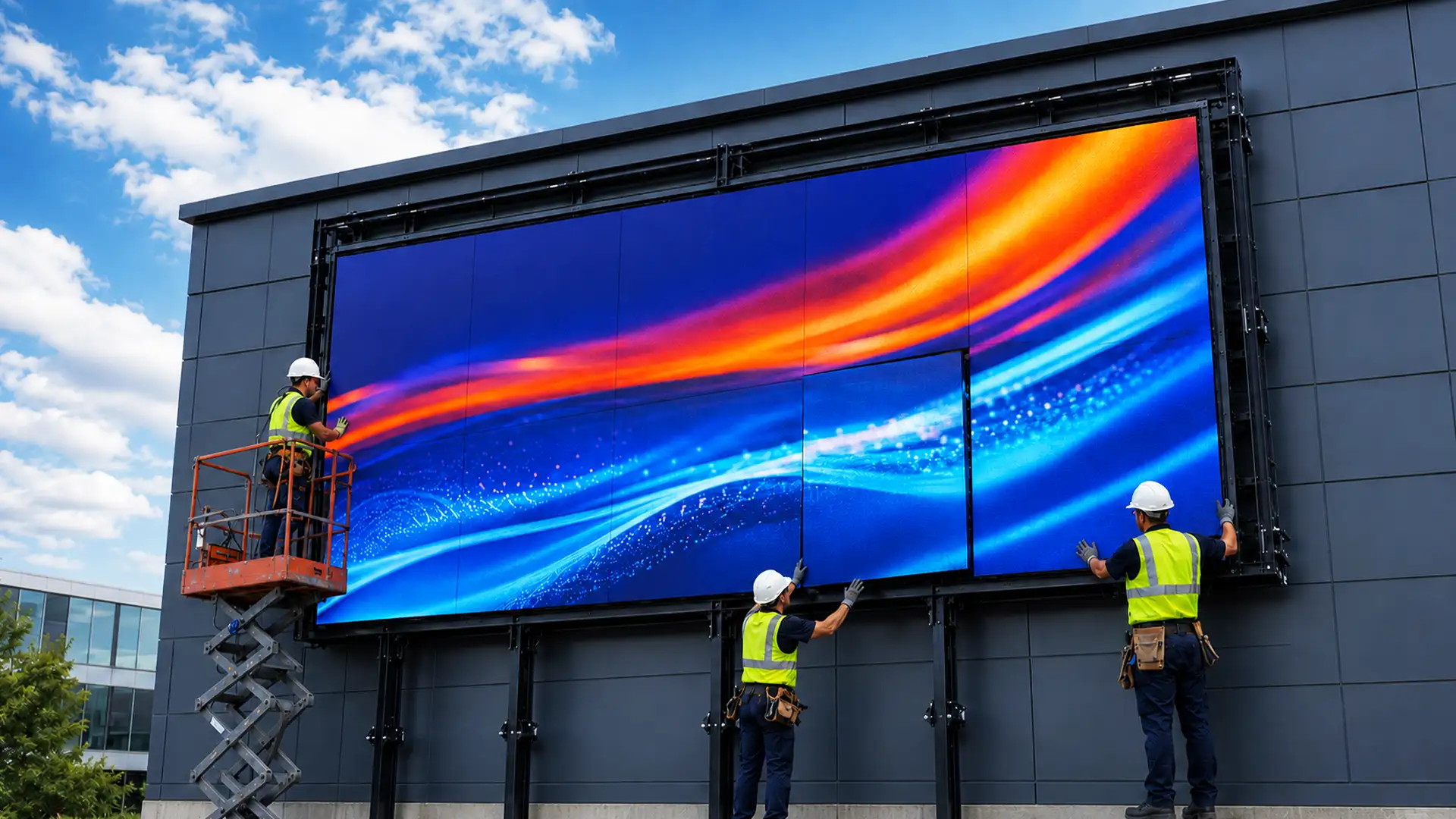
LED displays are assembled using modular cabinets that require precise alignment during installation. Even if there is a minor deviation in cabinet alignment , it can create visible seams and uneven surfaces.
As a result, you will notice gaps and non-uniform joints across the display. With time, this can also damage the connectors and modules.
To avoid this, you need accurate mounting structures, controlled installation tolerances, and proper cabinet locking mechanisms to maintain a seamless display surface.
Luminance and Color Non-Uniformity Due to Inadequate Calibration
After installation, you must calibrate the display to get uniform brightness and color output. Without this step, variations between modules become visible.
You may observe brightness differences, color shifts, or inconsistent grayscale levels across the screen. These LED calibration problems are more noticeable in large-format and fine pitch displays.
To avoid such visual glitches, every LED screen needs to undergo a proper calibration process—including white balance, grayscale correction, and gamma adjustment.
Improper Power Load Distribution and Electrical Design
During LED display installation, you need to ensure that power load is evenly distributed across all cabinets.
If power is not managed correctly, you may face flickering, voltage drops, overheating issues, or unexpected shutdowns in specific sections of the display.
You should plan a proper load distribution mechanism with proper circuit protection to avoid voltage drop, overload, and panel-level instability.
Signal Integrity and Data Mapping Configuration Errors
Your LED display depends on accurate signal transmission between controllers and modules. Errors in configuration or mapping disrupt how content appears on the screen.
If mapping is incorrect, you may see image distortion, misaligned visuals, or delayed output. These issues often result from incorrect addressing or poor signal routing.
You need proper configuration of sending and receiving systems, along with stable signal pathways, to ensure a synchronized display output.
Ingress Protection Failures in Outdoor Installations
If you are planning an outdoor LED display installation, protection against moisture, dust, and humidity must be addressed. Water ingress can lead to short circuits, corrosion, and module failure. These outdoor LED display installation mistakes usually result from improper sealing, poor cable entry protection, or incorrect cabinet design.
You need to use IP-rated enclosures, ensure proper sealing at all joints, and include drainage provisions to prevent moisture accumulation.
Our active LED displays come with IP-rated enclosures, protected cable interfaces, and controlled airflow design to reduce the risk of moisture ingress and environmental damage.
Here our some of our popular active LED Displays with their IP-ratings:
| Screen Type | Model | IP Rating |
|---|---|---|
| Fine Pitch LED Display | Spectra | Front IP60 / Back IP50 |
| Indoor LED Video Wall | Vega Series | Front IP30 / Back IP30 |
| Outdoor LED Video Wall | Earth Series | Front IP66 / Back IP66 |
Final Thoughts
Most LED display installation issues do not come from the display itself. They come from incorrect decisions made during planning and execution. Whether it is pixel pitch selection, cabinet alignment, calibration, power design, or environmental protection, each factor is responsible for how the display performs.
So before planning the next LED display installation in your space, you can reach out to Xtreme Media for installation or any kind of technical assistance.
Frequently Asked Questions
1. What are the most common LED display installation issues?
The most common LED display installation issues include:
- Incorrect pixel pitch selection
- Cabinet misalignment, improper power distribution
- Signal mapping errors
- Lack of calibration
2. How should you select the right pixel pitch for a display?
You should select pixel pitch based on viewing distance and content type.
3. What are the risks of poor ventilation in LED display installations?
Poor ventilation causes heat buildup, which leads to brightness drop, color shift, and faster degradation of LEDs and driver components.
4. What challenges arise when installing LED displays in indoor environments?
Indoor installations must address ambient lighting, viewing angles, space constraints, and proper mounting surface alignment.
5. How does outdoor location impact LED display installation requirements?
LED display installation in outdoor locations require higher brightness, IP-rated protection, wind load consideration, and resistance to temperature and moisture.